Showing posts with label artcollector. Show all posts

Wednesday, June 2, 2021

British Warship HMS Prince -Art Of Modification/Part Six


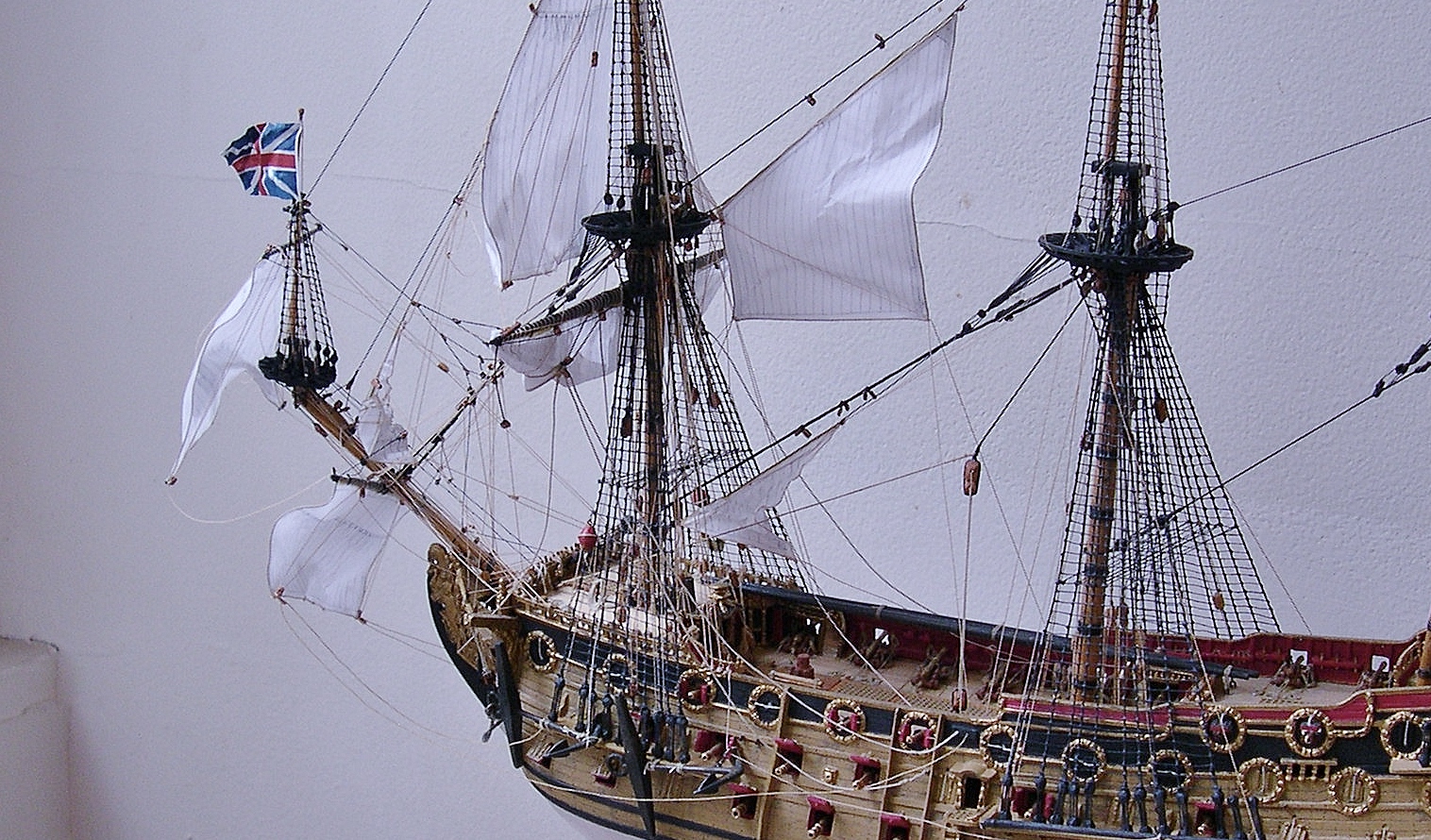
 This starboard overview show how beautiful and meticulous rigging can be when applied with careful assessment and patience. On such a small scale as this, it seem impossible to get the fine details (as such). But this can be achieved by working out the process in set stages -and scrutinizing each stage to make sure every possible line is applied. More is better if those lines can be fitted.

One of my greatest assets to period ships, especially miniatures, was my discovery of a chopstick method/system. With it, I was able to get difficult lines down to their belay points and finish with attractive coiling. Below, I apply this technique to the bow area where I secure the falls of the anchor bouys.


Rigging of any vessel requires concentration. Such can be seen with the partial tackle systems below...Notice the lines aren't fouling -and are properly spaced. Furthermore, the lines are led to points  that are logical for effective crew handling. 


Rigging caught my attention early on during my youth, especially when I frequented the Boys Club in our city. There was a Clipper ship model that sat above the bowling lane that I admired. I wanted to know the history behind the ship and build.; but most important to me was how the rigging was applied. So for several years I would study it and asked the manager if I could stay behind when it was time for the building to close (for dinner hours).

It wasn't long before I spent my Saturdays at home watching pirate movies. I studied every aspect of those ships and zoned in on the rigging. What I missed in the first viewing, I made notes; later waiting  for it to air again to get more information...Finally, my frequent library visits which started with my first book "The Ship" by author Bjorn Landstrom. That book, alone, opened up a new frontier of possibilities for me to excel as an artist-craftsman in the field of period ship models. His books (at that time) also assisted with my studies of various rigging lines.


We can never cease limiting our knowledge and/or abilities to improve and advance. Here, I am drawing a 'new' set of rigging plans based upon new discoveries of ignored processes. Since my first PRINCE of the 1980s, certain information weren't available -simply because home computers weren't a thing at that time. Now, with technology being what it is, there is a vast sea of information where one cannot be misinformed.


The above image is a perfect example of misinformation. What appears to be multiple lines on the left image is only a duplication of port and starboard belay points. Whereas the image on the left has many lines that have been researched and are not duplicated; but rather initialed 'p and s' which mean that this system of rigging will be featured port and starboard. Also, I was able to get 30 more lines rigged above the number count of the image at the left.


With better knowledge of the rigging process, it's now possible to customize the sails supporting the technique -leaving no guesswork. All lines are in place, ready to be led (in sequence) to their correct pins. The sail shown is the sprit sail.

Below, two views show the sprits and the effectiveness of motion in them...


Frontal starboard view showing sails and flag in a downwind...


Waterline view of same sails with furled jib. Here, the viewer can sense the movement of an imaginary wind...

Creating a sail (with attached rigging) can take up to three days, or more.


Here, the lines are clean and fall to their correct pins. Contemporary hobbyists and builders avoid complete rigging such as this because of either time constraints or inadequate knowledge of where the lines fall. So to avoid scrutiny, they just pass over the process and deem their pieces 'accurate'.

Such a word is baseless because it denotes totality and must be validated. I once embraced that, too; but realized as I matured in the art, the true premise for any 17th century ship is predicated on research. The more fact-based research, the better the model. Not so much the appearance, but the sweet evidence of the find...like the discovery of the Swedish ship Vasa.

The following six images will show updated rigging. It's been a complex and tedious affair, but well worth the effort relative to achieving the effect of true maritime -which is a science in and of itself...For instance, the Kensignton 'Science' Museum in London, England where the actual Prince (and other notable models) are housed is the result of painstaking research. This modified kit version is no exception.




There is not much more to say on this current blog except to leave you with these last two images in closing.

Any kit has promise to be something both breathtaking and extraordinary at the same time. It's really how one see the glass, whether it be half empty or half full. This is true with modelmaking.  Laying eyes on these kits during my youth touched me in such a way to get the community involved. I was poor and didn't have the resources to get the 'right' materials to re-create the visions I knew were possible; not until I came across local business executives.

They had the money; I had the vision...

I pointed them to what I needed and they wrote the checks. These images are the result of what kindness can do; and that kindness extended forty years to 'today'. I had a vision to take three kits from a British manufacturer and mold them into miniature masterpieces -using Scripture of "a little here, a little there. Precept upon precept; line upon line"...and, I'm doing it.


I don't know what the final outcome will be when this final model of the Trilogy Series is finished. I can only hope these will be honored 'somewhere'. The main thing is that I'm finishing a four-decade old  project that expands two centuries (1980 - 2021)...It doesn't get any better.

I hope to have this piece completed in several weeks; so until, keep viewing! 

Fairwinds, and thank you.


Wednesday, March 3, 2021

H.M.S. PRINCE -The Airfix Modification...Part Three/ Rex Stewart


 This third series addresses deck layout, rigging and belay points. There is much to say on this subject, but from this above image, I need to say very little. In short, the information is out there...and can be very beneficial -provided time is taken to find it.

Many Prince models I've seen were rushed to ruin because the builder took on the persona of 'oh well' after realizing errors. This is why I'm adamant about careful study and what I research. If quality is the objective, then persistence and patience must be practiced at 'your' pace. It's 'your' model and 'your' perception on how 'you' want it to be. Whether mediocre or fine, the decision is 'yours'...and you must be happy with it.

During the 1980s and '90s many builders were in competition with one another to grab that 'spotlight' -especially in the arena of sailing ships. As a result, there was mass confusion about ships, their design, rigging methods, etc., etc. Even galleries climbed aboard to promote their 'superstars' until I arrived.

To that end, I faced opposition from all sides, but weathered those storms of vanity to be persistent in my chosen livelihood -with extended support from real experts whom provided me the jewels of their findings. I discovered a page of history unfolding because many were women.

This third series will not be about technique(s), rather about the process as to how I came about my findings -starting with the first images below:

As a rule of thumb I build my models by correctly scaling them; and making changes to kits that don't accurately have the pieces in sync with the build. This is done by drawing a figure to match the model's scale and the supporting items. Most of the time I find that I must discard these items and replace them with custom pieces to match what's on the template. By doing this early, the rigging process becomes less taxing.

The three principle areas of focus I consider for a build such as this are doors, stairwells, and railings. If these elements conform to scale, then everything else will fit accordingly. This closeup view show the doors, stairwell and railing system which I modified to give the appearance of a real ship. There's yet much to do...

Another closeup showing the quarter and poop deck stairs and bulkheads. The plastic windows were removed and replaced with acetate. The doors were tedious by way of removing; these were adjusted in open position with shaved basswood. I find that doors fully and partially open tend to be more attractive -bringing the viewer to it.

Port overview showing the progress of the main and quarter decks. In the Airfix kit limited grating was featured, so I improvised and made the grates for every deck except the poop -or roundhouse deck. I noticed this to be true for other kits on this subject; but the reality was that ships needed these grates to have ventilation -especially when engaging the enemy. The smoke needed a place to escape and the gratings were created for that purpose. Unfortunately, many modelers miss this...or choose not to place them effectively. 

This overview show the complete deck and grating system for PRINCE. 


Another flaw are admiralty type models which are used for a project's absolute...They are not 'absolutes' -they are study models.There must be an understanding what is meant by an admiralty model from this period. Like any ship model of this era, these were prototypes created to present the Admiralty a three dimensional schematic of what the ship might look like. It was not the conclusion, as features were added and/or dismissed during the actual build. Furthermore, rigging was at the discretion of the captain and/or ranking officer, so even in that area nothing was yet conclusive until the vessel went to its sea trials. This is where I encourage modelers to seriously study the basic rigging practices of the period and incorporate it before presenting the word 'museum quality'.

This is not a play on words; serious modelmakers know this.

Below is one of my notable woodsculpted dioramas that I created in the 1990s depicting "The Admiralty c.1660". Here, the Admiralty members are viewing a vessel prototype before it's voted upon for construction. Since that time I only produced two of these which were immediately bought -and since I'm working on PRINCE, I will probably produce my third and last diorama to honor the Airfix Trilogy.


The next views of the build highlight the detail to the forecastle. I studied many PRINCE models to make a fair assessment of the ship. Applying what I studied and researched, this is my conclusion. I noticed that there were no bitts shown at the foremast base. It's obvious that these were there based on paintings and drawings showing rigging leading down to that area. Furthermore, the conclusion of the matter lies with Vasa that was raised in 1961 and the restoration of both USS Constitution and England's HMS VICTORY. 

Bitts lightened the stress of the massive yards and sails -which occasionally had tackles to assist. However, the bitts and knightheads (part of the bitts system) had to be reinforced by way of the deck and not the rail. Again, the admiralty model did not serve its purpose here because I strongly believe it was only emphasizing possibilities. But based on the evidence of Constitution, Vasa, and Victory this feature was essential.

Airfix Prince model looking forward showing enhanced detailing of the forecastle. The belfry was solid which was customized to include the brass bell. Both cabin doors are open so it can afford the viewer  observance of the open ports and cannon. On the forecastle deck behind the belfry are the bitts and galley stack.

Another angle from starboard...

And finally, a starboard profile...

This concludes the decking process on a much heralded kit from Airfix. What makes this kit worthy of build are the many variations one can do with it. Even if I were to build another, it would look entirely different from this; albeit probably one without sails.

The guns and boats are now the next step before addressing the masts. Below, are images of how miniature (and detailed) this will be. One gun alone with full tackle take about two to three hours; but, well worth the investment for achieving a quality model.


It's been a pleasure featuring this build up to this stage -and I hope the next blog will go further in depth regarding the tackle systems, rigging and other details that may have been overlooked in previous Prince models.

Thanks for viewing!